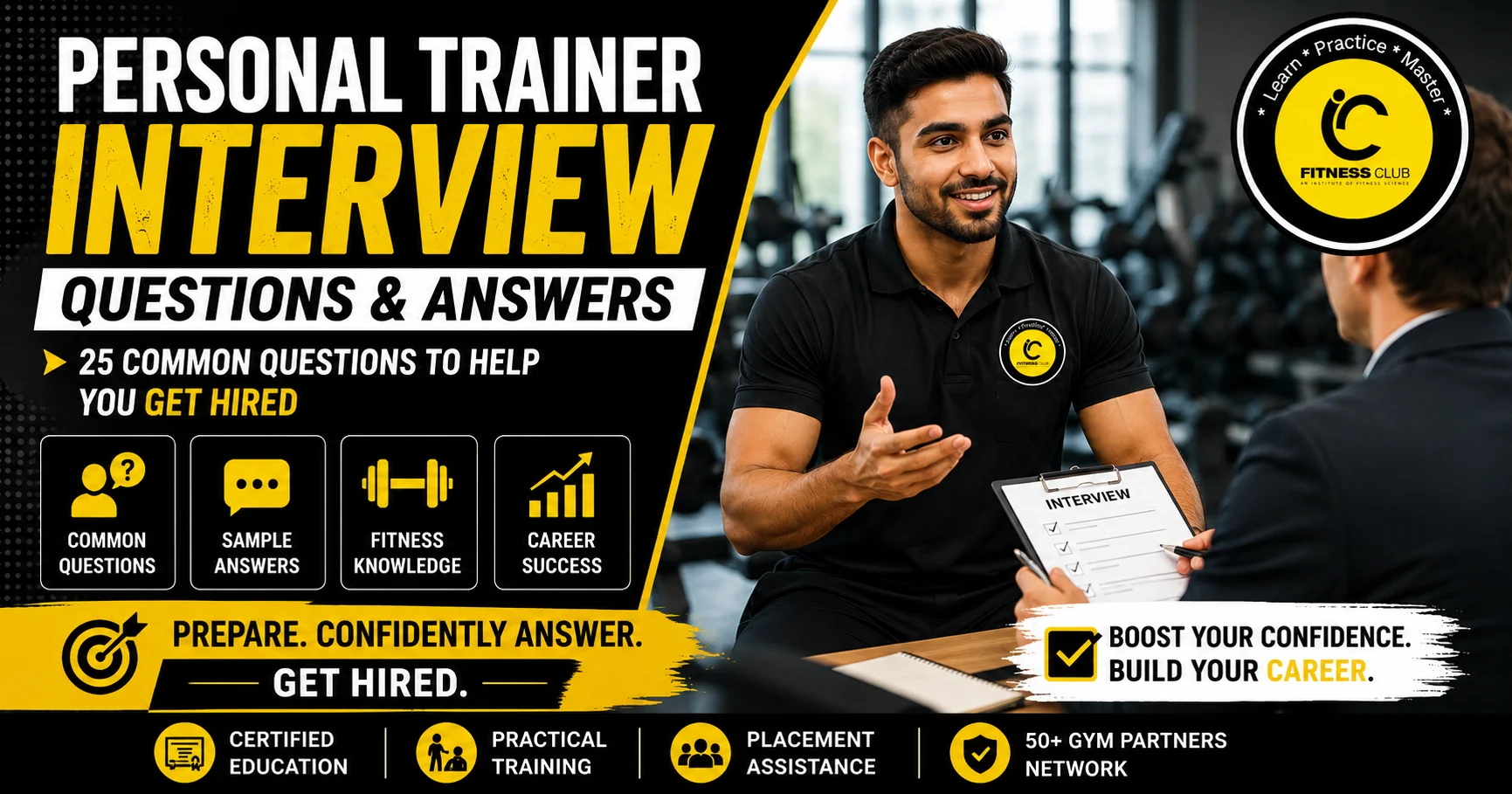
Personal Trainer Interview Questions & Answers: 25 Common Questions to Help You Get Hired
Landing your first job as a Personal Trainer can be exciting, but the interview process often feels intimidating. Employers look beyond your certification—they want to understand your knowledge, communication skills, professionalism, and ability to work with clients.
Preparing for common interview questions can help you answer confidently and increase your chances of getting hired.
In this guide, we’ve compiled 25 frequently asked Personal Trainer interview questions with sample answers to help you succeed.
1. Tell us about yourself.
Sample Answer
“I’m passionate about fitness and helping people improve their health. I completed my Personal Trainer certification to build a career where I can guide clients safely using scientific training methods and personalized workout programs.”
2. Why do you want to become a Personal Trainer?
Sample Answer
“I enjoy motivating people and helping them achieve their fitness goals. Seeing clients improve their health and confidence is what motivates me.”
3. What qualifications do you have?
Mention:
- Personal Trainer Certification
- CPR & First Aid Certification
- Sports Nutrition Certification (if applicable)
- Strength & Conditioning certifications
4. Why should we hire you?
Sample Answer
“I combine scientific knowledge with practical coaching skills. I communicate well with clients, prioritize safety, and continuously update my knowledge to provide effective training.”
5. How do you assess a new client?
A proper assessment typically includes:
- Medical history
- Fitness goals
- Lifestyle habits
- Body composition
- Mobility assessment
- Movement screening
6. How would you motivate an unmotivated client?
Good trainers:
- Listen carefully
- Set realistic goals
- Celebrate progress
- Provide encouragement
- Make workouts enjoyable
7. How do you design a workout program?
Explain that programs should be based on:
- Client goals
- Fitness level
- Medical history
- Training experience
- Progressive overload
- Recovery needs
8. What would you do if a client performs an exercise incorrectly?
Always prioritize safety.
Correct technique politely, demonstrate proper form, reduce the weight if necessary, and explain why proper movement is important.
9. How do you handle difficult clients?
Remain professional.
Listen actively, understand their concerns, communicate respectfully, and work together to find solutions.
10. What are SMART goals?
SMART stands for:
- Specific
- Measurable
- Achievable
- Relevant
- Time-bound
Employers often ask this question.
11. Explain Progressive Overload.
Progressive overload means gradually increasing training demands to improve strength, endurance, or muscle growth while allowing adequate recovery.
12. What is the difference between compound and isolation exercises?
Compound exercises involve multiple joints and muscle groups.
Examples:
- Squat
- Deadlift
- Bench Press
Isolation exercises target one muscle group.
Examples:
- Bicep Curl
- Leg Extension
- Triceps Pushdown
13. Why is warm-up important?
A proper warm-up:
- Increases body temperature
- Improves mobility
- Activates muscles
- Reduces injury risk
- Enhances performance
14. What is Progressive Overload?
Employers may ask this more than once in different ways.
Explain that gradual increases in training volume, intensity, frequency, or resistance stimulate continued adaptation.
15. How do you retain clients?
Successful trainers:
- Track progress
- Build relationships
- Communicate regularly
- Educate clients
- Deliver consistent results
16. What is your biggest strength?
Choose strengths like:
- Communication
- Discipline
- Scientific knowledge
- Patience
- Leadership
17. What is your biggest weakness?
Choose a weakness you’re actively improving.
Example:
“I’m continually improving my public speaking confidence by conducting more group sessions.”
18. How do you stay updated with fitness science?
Mention:
- Research articles
- Workshops
- Continuing education
- Industry certifications
19. What would you do if a client misses sessions?
Contact them professionally, understand the reason, encourage consistency, and help them get back on track.
20. How would you sell Personal Training?
Focus on solving problems rather than selling.
Understand client goals, explain benefits, and recommend suitable training plans.
21. What are the qualities of a good Personal Trainer?
A successful trainer should have:
- Scientific knowledge
- Communication skills
- Patience
- Professionalism
- Leadership
- Empathy
- Continuous learning mindset
22. What would you do in a medical emergency?
Immediately stop the workout, assess the situation, provide First Aid or CPR if trained, and seek emergency medical assistance when required.
23. What is client confidentiality?
Personal Trainers must protect client health information, assessment records, and personal details while maintaining professionalism.
24. Where do you see yourself in five years?
Employers appreciate ambition.
Example:
“I hope to become an experienced Personal Trainer, build long-term client relationships, continue my education, and eventually mentor new trainers.”
25. Do you have any questions for us?
Always ask thoughtful questions such as:
- What opportunities are available for career growth?
- Is continuing education supported?
- What type of clients will I work with?
- What does success look like in this role?
Tips to Crack a Personal Trainer Interview
✔ Research the gym before your interview.
✔ Dress professionally.
✔ Arrive on time.
✔ Practice answering common questions.
✔ Demonstrate confidence without arrogance.
✔ Emphasize client safety.
✔ Show enthusiasm for helping people.
Why Practical Training Makes a Difference
Knowledge alone isn’t enough to succeed in an interview. Employers value candidates who have practical coaching experience, understand exercise technique, and can confidently interact with clients.
At IC Fitness Club – Institute of Fitness Science, our Diploma in Personal Trainer Course combines scientific education with hands-on practical training. Students also benefit from placement assistance through our network of 50+ gym partners and the Gymploy.com WhatsApp placement community, helping them connect with career opportunities after certification.
👉 Explore our Diploma in Personal Trainer Course:
Personal Trainer Course in Delhi | Diploma Program | IC Fitness Club
🌐 Visit IC Fitness Club:
Frequently Asked Questions
What questions are asked in a Personal Trainer interview?
Common questions cover client assessment, workout programming, motivation, exercise technique, communication skills, and fitness knowledge.
How can I prepare for a Personal Trainer interview?
Review exercise science fundamentals, practice answering common interview questions, understand client assessment, and improve your communication skills.
Do gyms require certification before hiring a Personal Trainer?
Most professional gyms prefer candidates with a recognized Personal Trainer certification along with practical coaching experience and CPR/First Aid training.
Final Thoughts
A successful Personal Trainer interview is about more than memorizing answers. Employers want to see confidence, professionalism, practical knowledge, and a genuine passion for helping clients achieve their fitness goals.
By preparing for these common interview questions and continuing to improve your practical skills, you’ll be well-equipped to make a strong impression and begin a rewarding career in the fitness industry.