
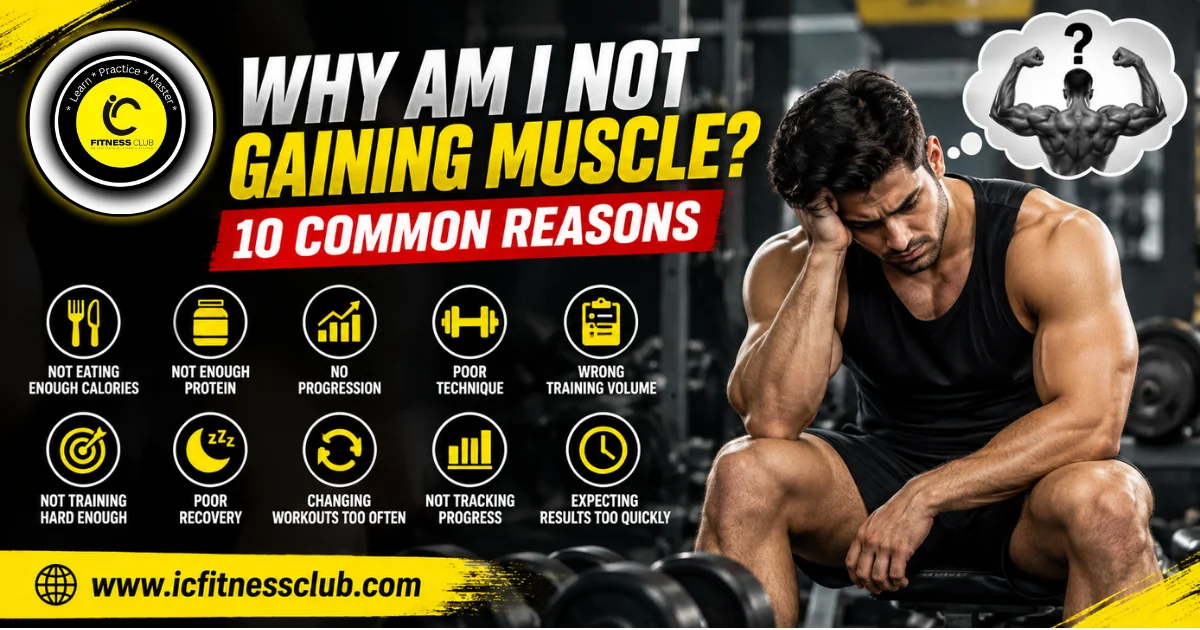
Why Am I Not Gaining Muscle? 10 Common Reasons
Building muscle takes more than simply spending time in the gym. You can train consistently and still struggle to see noticeable progress if your nutrition, recovery, training structure, or progression isn’t supporting your goal.
If you’ve been working out for months but aren’t gaining as much muscle as expected, there may be several factors worth examining.
Here are 10 common reasons you may not be gaining muscle and what you can do about them.
1. You’re Not Eating Enough Calories
One of the most common reasons for slow muscle gain is simply not consuming enough energy.
Building new muscle tissue requires energy. If your calorie intake is consistently too low, gaining body mass can become difficult even when your training is well structured.
This doesn’t mean you need to eat as much as possible.
A controlled calorie surplus can be more practical than dramatically increasing food intake.
What to do
Track your food intake for a period of time and monitor your body weight and performance.
If your weight isn’t increasing and muscle gain is your goal, your overall calorie intake may need adjustment.
2. You’re Not Getting Enough Protein
Protein provides amino acids needed for muscle protein synthesis and tissue repair.
Good protein sources include:
- Eggs
- Chicken
- Fish
- Lean meat
- Dairy products
- Soy
- Beans and legumes
- Protein supplements when useful
Instead of relying on one large protein-heavy meal, distributing protein across your meals can make it easier to consistently meet your daily needs.
The appropriate amount depends on factors such as body size, total diet, training, and individual circumstances.
3. Your Training Isn’t Progressing
Simply completing the same workout every week doesn’t guarantee continued progress.
Your body adapts to training.
Progressive overload can involve gradually increasing:
- Weight
- Repetitions
- Sets
- Exercise difficulty
- Range of motion
- Training quality
For example, if you perform the same exercise with the same load and repetitions for months without improving performance, your training stimulus may need to be reassessed.
Progress doesn’t always mean adding weight every session. The progression method should fit the exercise and program.
4. You’re Training With Poor Technique
Moving heavy weights isn’t the same as effectively training a muscle.
Poor technique can:
- Reduce the intended training stimulus
- Make exercises less consistent
- Increase unnecessary fatigue
- Make progression difficult to track
Focus on controlled, repeatable technique and an appropriate range of motion rather than simply chasing heavier numbers.
This is especially important when learning new exercises.
5. Your Training Volume May Be Too Low—or Too High
Training volume is another important factor.
Too little training may provide insufficient stimulus.
But more isn’t automatically better.
Excessive volume can contribute to accumulated fatigue and interfere with recovery and performance.
The appropriate amount varies between individuals and can change as training experience increases.
A good program balances stimulus, fatigue, and recovery.
6. You’re Not Training Hard Enough
Muscle growth generally requires challenging resistance training.
If every set is performed far away from meaningful effort, the training stimulus may not be sufficient.
This doesn’t mean every set needs to be taken to absolute failure.
Instead, tools such as RIR (Reps in Reserve) can help estimate how close a set is to failure.
For example:
3 RIR = approximately three good repetitions could still be performed.
1 RIR = approximately one repetition remains.
Understanding training effort can help make workout programming more consistent.
7. You’re Not Recovering Properly
Muscle doesn’t grow simply because you train.
Training creates a stimulus, while recovery provides the conditions for adaptation.
Recovery includes:
- Sleep
- Nutrition
- Rest
- Stress management
- Appropriate training volume
If you’re constantly fatigued and your performance is declining, the solution may not be adding more training.
Sometimes the program needs better recovery management.
8. You’re Changing Your Workout Too Often
Another common mistake is constantly searching for a new workout.
One week you’re following Full Body.
The next week you’re doing Push Pull Legs.
Then you switch to a completely different bodybuilding routine.
Frequent changes make it difficult to determine whether you’re actually progressing.
A structured program should generally be followed long enough to evaluate:
- Performance
- Recovery
- Exercise technique
- Training volume
- Progression
Consistency gives you useful data.
9. You’re Not Tracking Your Progress
If you don’t measure your training, it can be difficult to know whether you’re actually progressing.
Useful things to track include:
- Body weight
- Exercise loads
- Repetitions
- Sets
- Measurements
- Progress photos
- Training performance
Don’t rely exclusively on the weighing scale.
Muscle gain can occur without dramatic changes in body weight, particularly when body composition is changing.
10. You’re Expecting Results Too Quickly
Muscle growth takes time.
Social media can make progress appear much faster than it actually is because people often share transformations without showing the months or years of training behind them.
Your rate of progress can also vary depending on:
- Training experience
- Genetics
- Nutrition
- Recovery
- Program quality
- Starting body composition
- Consistency
Instead of judging progress from week to week, look for trends over a longer period.
A Simple Muscle-Gain Checklist
If you’re struggling to gain muscle, review these areas:
Training
- Am I following a structured program?
- Am I progressively improving performance?
- Is my technique consistent?
- Is my training volume appropriate?
Nutrition
- Am I eating enough?
- Am I consuming adequate protein?
- Is my overall diet supporting my goal?
Recovery
- Am I getting sufficient sleep?
- Am I managing fatigue?
- Am I allowing adequate recovery between demanding sessions?
Tracking
- Am I recording my workouts?
- Am I monitoring body weight and measurements?
- Am I evaluating progress over several weeks rather than a few days?
Final Thoughts
Not gaining muscle doesn’t always mean you need a completely new workout.
Sometimes the solution is improving one of the fundamentals:
Eat appropriately. Train progressively. Recover properly. Track your progress. Stay consistent.
Muscle building is a long-term process, and effective training is about gradually improving the quality and stimulus of your program.
For personal trainers, understanding these principles is essential when designing programs and helping clients troubleshoot stalled progress.
Learn More About Personal Training
Learn practical workout programming, exercise science, and personal trainer skills with IC Fitness Club – Institute of Fitness Science.
Explore the Personal Trainer Course
Related Reading
Strength Training vs Hypertrophy Training
Workout Split Guide: Full Body vs Upper/Lower vs PPL