

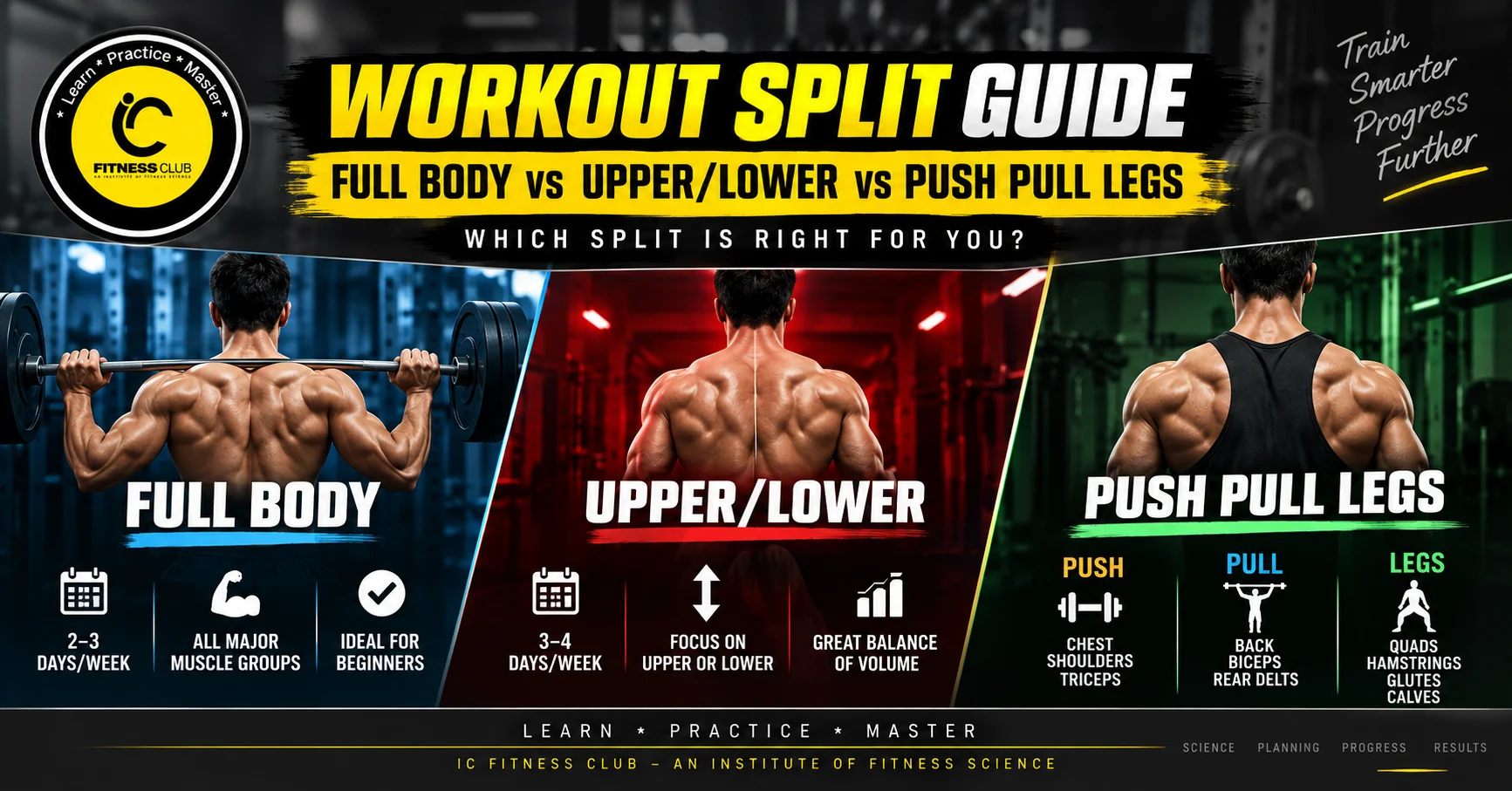
Workout Split Guide: Full Body vs Upper/Lower vs Push Pull Legs
Choosing the right workout split is one of the most important parts of designing an effective training program. A workout split determines how training sessions are organized throughout the week and how often different muscle groups are trained.
There is no single “best” workout split for everyone. The right choice depends on the client’s training experience, schedule, recovery ability, goals, exercise preferences, and weekly training frequency.
Three popular approaches are:
- Full Body
- Upper/Lower
- Push Pull Legs (PPL)
This guide explains how each split works, its advantages and limitations, and how personal trainers can choose the right option for different clients.
What Is a Workout Split?
A workout split is a method of organizing resistance training sessions across the week.
Instead of training every muscle in the same way every session, a split can divide training based on:
- Muscle groups
- Movement patterns
- Training goals
- Training frequency
- Recovery requirements
For example, someone training three days per week might use a Full Body routine, while someone training four days could use an Upper/Lower split.
The goal is not simply to create more complicated workouts. The goal is to organize training so that the client can make consistent progress while managing fatigue and recovery.
1. Full Body Workout Split
A full-body workout trains multiple major muscle groups during the same session.
A typical session might include:
- Squat or leg press
- Horizontal press
- Row
- Hip hinge
- Vertical pull
- Core exercise
The exact exercise selection depends on the individual and their goals.
Example: 3-Day Full Body Routine
Monday
- Squat
- Bench Press
- Seated Row
- Romanian Deadlift
- Core
Wednesday
- Leg Press
- Overhead Press
- Lat Pulldown
- Leg Curl
- Core
Friday
- Split Squat
- Incline Dumbbell Press
- Cable Row
- Hip Thrust
- Calf Raises
The exercises can be changed or progressed according to the client’s program.
Advantages of Full Body Training
1. Efficient for lower training frequencies
It allows a client to train major muscle groups multiple times per week even when they only have a few training days.
2. Useful for beginners
Beginners can repeatedly practice fundamental movement patterns without requiring a complicated weekly schedule.
3. Flexible
If a client misses one session, they have less risk of completely missing a particular muscle group for the week.
4. Good for general fitness
Full-body training can work well when the client’s goal is overall strength, muscle development, and fitness rather than highly specialized bodybuilding.
Limitations
As training volume increases, fitting everything into one session can make workouts longer and potentially reduce performance toward the end of the session.
2. Upper/Lower Workout Split
The Upper/Lower split divides training into two categories:
Upper Body
- Chest
- Back
- Shoulders
- Biceps
- Triceps
Lower Body
- Quadriceps
- Hamstrings
- Glutes
- Calves
- Core, depending on programming
A common setup is four training days per week.
Example
Monday – Upper
- Bench Press
- Row
- Overhead Press
- Lat Pulldown
- Biceps Curl
- Triceps Extension
Tuesday – Lower
- Squat
- Romanian Deadlift
- Leg Press
- Leg Curl
- Calf Raise
Thursday – Upper
- Incline Press
- Pull-Up or Pulldown
- Dumbbell Shoulder Press
- Cable Row
- Lateral Raise
- Arms
Friday – Lower
- Deadlift variation
- Split Squat
- Hip Thrust
- Leg Extension
- Leg Curl
- Calves
Advantages of Upper/Lower
1. Good balance between frequency and volume
It provides enough training opportunities for each muscle group while allowing sessions to focus on fewer areas than a full-body routine.
2. Useful for intermediate trainees
Clients who have moved beyond beginner-level training can often benefit from having dedicated upper and lower sessions.
3. Flexible scheduling
It can be adapted to three, four, or more weekly sessions depending on the program.
4. Easier volume distribution
Training volume can be spread across multiple sessions instead of placing too much work into one workout.
Limitations
It generally requires more weekly training days than a traditional full-body routine if you want to train both upper and lower body twice per week.
3. Push Pull Legs (PPL)
Push Pull Legs divides training according to movement patterns and the muscles primarily responsible for those movements.
Push
Usually includes:
- Chest
- Front and lateral deltoids
- Triceps
Pull
Usually includes:
- Back
- Rear deltoids
- Biceps
Legs
Usually includes:
- Quadriceps
- Hamstrings
- Glutes
- Calves
Example: 3-Day PPL
Monday – Push
- Bench Press
- Incline Dumbbell Press
- Shoulder Press
- Lateral Raise
- Triceps Extension
Wednesday – Pull
- Lat Pulldown
- Barbell or Cable Row
- Rear Delt Fly
- Face Pull
- Biceps Curl
Friday – Legs
- Squat
- Romanian Deadlift
- Leg Press
- Leg Curl
- Calf Raise
PPL can also be structured across six training days, with Push, Pull and Legs repeated during the week.
Advantages of PPL
1. Allows focused sessions
Each workout can concentrate on a smaller group of muscles and movements.
2. Useful for higher training frequencies
A six-day PPL structure can provide frequent training opportunities while distributing volume across the week.
3. Convenient for exercise selection
Exercises can be grouped according to their primary movement patterns.
4. Popular among hypertrophy-focused trainees
It can provide plenty of room for exercise variety and volume when appropriately programmed.
Limitations
A traditional six-day PPL routine requires a significant time commitment.
If someone frequently misses training days, the structure can also become less predictable.
Full Body vs Upper/Lower vs PPL
| Feature | Full Body | Upper/Lower | Push Pull Legs |
|---|---|---|---|
| Training frequency | Usually 2–4 days | Usually 3–4+ days | Usually 3–6 days |
| Session focus | Whole body | Upper or lower | Push, pull or legs |
| Beginner-friendly | ⭐⭐⭐⭐⭐ | ⭐⭐⭐⭐ | ⭐⭐⭐ |
| Time efficiency | High | Moderate–High | Moderate |
| Volume distribution | Moderate | Good | Very good |
| Exercise variety | Moderate | High | High |
| Scheduling flexibility | High | High | Moderate |
| Higher-volume training | Moderate | Good | Very good |
| Recovery management | Usually straightforward | Good | Requires more planning |
These ratings are practical programming considerations rather than strict rules. A skilled trainer can modify any split according to the client’s needs.
Which Workout Split Is Best for Beginners?
For many beginners, Full Body training is a practical starting point.
A beginner often benefits from:
- Learning basic movement patterns
- Practicing exercises regularly
- Managing training fatigue
- Building consistency
- Developing basic strength and coordination
A complicated split is not automatically a better program.
The best beginner program is one the client can perform consistently and progress over time.
Which Split Is Best for Building Muscle?
All three splits can support muscle growth when the overall program provides appropriate:
- Training volume
- Exercise selection
- Effort
- Progressive overload
- Recovery
- Nutrition
The split itself does not create hypertrophy.
For example, a well-designed Full Body program can produce excellent results, just as an appropriately structured PPL program can.
The important question is:
Can the split help distribute productive training volume while allowing the client to recover and progress?
Which Split Is Best for Strength?
Strength development can also be achieved using different workout structures.
A trainer may select a split based on:
- The client’s strength goals
- Main lifts or movement patterns
- Training experience
- Weekly availability
- Recovery capacity
For a beginner learning foundational movements, Full Body training may provide frequent practice.
For a more experienced trainee, Upper/Lower or another structured split may make it easier to distribute heavier training and supporting exercises.
How Personal Trainers Should Choose a Workout Split
A personal trainer should not select a workout split simply because it is popular.
Start with the client.
1. Determine Training Frequency
Ask:
How many days can the client realistically train every week?
Someone who can train twice or three times per week may benefit from a different structure than someone who consistently trains five or six days.
2. Consider Training Experience
Beginners generally need simpler programming and more opportunities to practice fundamental movements.
More experienced trainees may require greater specialization and volume distribution.
3. Consider the Goal
Is the client primarily interested in:
- General fitness?
- Strength?
- Muscle growth?
- Sports performance?
- Fat loss?
- Improving specific muscle groups?
The goal influences how training volume and exercises should be organized.
4. Consider Recovery
Training frequency should match the individual’s ability to recover.
Consider:
- Sleep
- Work demands
- Stress
- Training intensity
- Total weekly volume
- Other physical activities
5. Consider Client Preference
Adherence matters.
A theoretically excellent program is not useful if the client does not enjoy it or cannot consistently follow it.
Workout Split Example Based on Training Frequency
2 Days Per Week
Full Body
A full-body approach is often practical because both sessions can address the major movement patterns.
3 Days Per Week
Full Body
For example:
Monday – Full Body
Wednesday – Full Body
Friday – Full Body
Alternatively, some clients may use a modified split depending on their goals.
4 Days Per Week
Upper/Lower
Monday – Upper
Tuesday – Lower
Thursday – Upper
Friday – Lower
5 Days Per Week
There are many possible structures. A trainer can distribute volume according to the client’s priorities rather than automatically following a fixed template.
6 Days Per Week
Push/Pull/Legs
Monday – Push
Tuesday – Pull
Wednesday – Legs
Thursday – Push
Friday – Pull
Saturday – Legs
Sunday – Rest
Again, six training days are not automatically superior. More training only helps when the trainee can recover and maintain performance.
Common Workout Split Mistakes
1. Choosing a Split Because It Is Popular
A popular routine may not be appropriate for every client.
2. Ignoring Training Frequency
A six-day routine is unlikely to be practical for someone who can realistically train only three days.
3. Adding Too Much Volume
Changing from Full Body to PPL does not automatically mean more volume is necessary.
4. Ignoring Recovery
More sessions can mean more accumulated fatigue.
5. Frequently Changing the Program
Clients need enough time to practice exercises, adapt, and demonstrate progression.
6. Focusing on the Split Instead of Progressive Overload
The split is only the structure.
Progress comes from appropriately progressing the training stimulus over time.
Workout Split and Progressive Overload
Regardless of the split, a good program needs a progression strategy.
Progression can involve:
- Increasing load
- Increasing repetitions
- Increasing sets when appropriate
- Improving technique
- Increasing range of motion
- Managing effort through RIR/RPE
- Improving exercise execution
For example, if a client performs 3 sets of 8 repetitions with good technique, the trainer may gradually increase the training challenge according to the program’s progression model.
The workout split determines how training is organized.
Progressive overload determines how the training stimulus develops over time.
Frequently Asked Questions
Is Full Body better than PPL?
Not necessarily. The better option depends on the client’s training frequency, goals, experience, recovery, and preferences.
Can beginners do Push Pull Legs?
Yes, but a traditional six-day PPL may be unnecessarily demanding for many beginners. A simpler structure can often be easier to follow.
Is Upper/Lower good for muscle growth?
Yes. Upper/Lower can provide an effective way to distribute training volume and frequency for muscle development.
Do I need to train six days per week to build muscle?
No. Muscle growth can be achieved with different training frequencies when the overall program is appropriately designed.
Should the workout split change regularly?
Not necessarily. A program should generally be given enough time for the trainer to evaluate performance, progression, recovery, and adherence before making major changes.
Final Takeaway
Full Body, Upper/Lower, and Push Pull Legs can all be effective workout splits.
The best split isn’t the one that looks most advanced. It’s the one that fits the individual’s:
Goal + Schedule + Experience + Recovery + Preferences
For beginners and clients with limited training days, Full Body can be highly practical.
For clients training around four days per week, Upper/Lower can provide an effective balance.
For experienced trainees who enjoy higher training frequency and need greater volume distribution, PPL can be a useful option.
For personal trainers, the key skill is not memorizing workout splits—it’s knowing why, when, and how to use them.
Learn More About Personal Training
At IC Fitness Club – Institute of Fitness Science, personal trainer education combines scientific concepts with practical gym training to help students develop the skills needed to design and coach effective workout programs.
Explore the Personal Trainer Course:
Personal Trainer Course in Delhi | Diploma Program | IC Fitness Club