

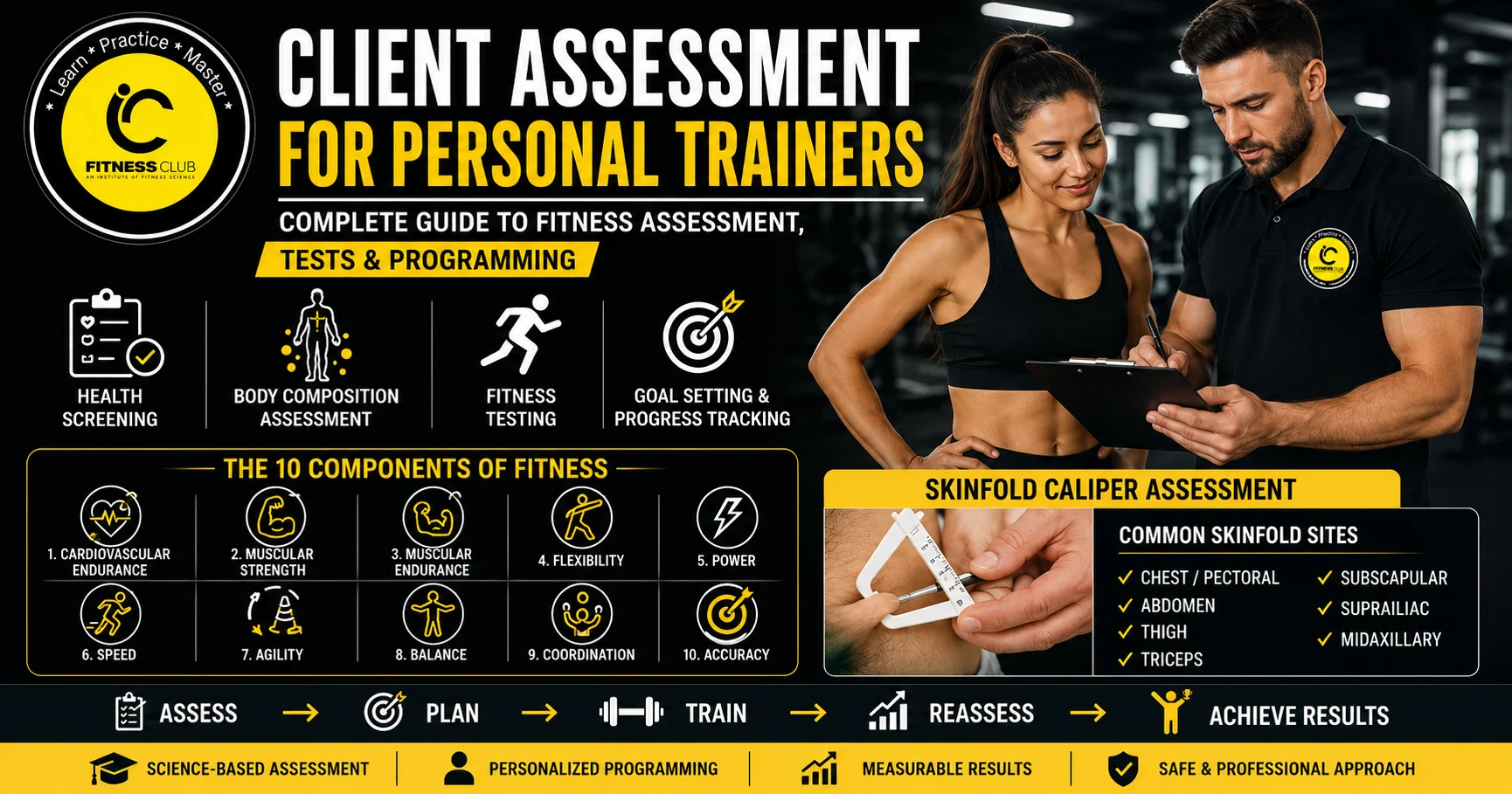
Client Assessment for Personal Trainers: Complete Guide to Fitness Assessment, Tests & Programming
Client assessment is one of the most important skills a Personal Trainer needs to develop. Before designing a workout program, a trainer should understand the client’s goals, health history, current fitness level, lifestyle, movement abilities, and training experience.
A proper client assessment for Personal Trainers provides a starting point for exercise programming, helps establish measurable baselines, and allows trainers to monitor progress over time.
Client assessment is much more than checking body weight. A professional assessment can include health screening, goal setting, body composition assessment, movement assessment, fitness testing, and progress tracking.
In this guide, we’ll cover the complete client assessment process, including the 10 components of fitness, common assessment tests, skinfold caliper sites, workout programming, and reassessment.
What Is Client Assessment?
Client assessment is the process of collecting relevant information about an individual’s health, fitness, goals, lifestyle, physical capabilities, and exercise history before and during a training program.
It helps a Personal Trainer understand:
- What does the client want to achieve?
- What is their current fitness level?
- What training approach is appropriate?
- Which exercises should be selected?
- What factors may require exercise modification?
- How should the program progress?
- How can progress be measured?
Assessment should not be considered a one-time event. Selected assessments can be repeated periodically to evaluate progress and modify the training program.
Why Is Client Assessment Important?
A structured assessment helps Personal Trainers:
1. Understand Client Goals
Clients may want to achieve:
- Fat loss
- Muscle gain
- Strength development
- Improved cardiovascular fitness
- General fitness
- Better mobility
- Sports performance
- Improved muscular endurance
Understanding the primary goal helps determine which assessments and training methods are appropriate.
2. Establish a Baseline
Initial measurements and fitness tests provide a starting point. Future assessments can be compared with the baseline to monitor changes.
3. Personalize Training
Two clients can have the same goal but completely different fitness levels and training requirements.
Assessment helps trainers create individualized programs instead of using the same workout for everyone.
4. Monitor Progress
Regular reassessment can provide objective information about changes in fitness, body composition, strength, endurance, and performance.
Step 1: Client Consultation
The assessment process should begin with a consultation.
A Personal Trainer may collect information about:
- Age
- Training experience
- Current activity level
- Fitness goals
- Occupation
- Lifestyle
- Sleep habits
- Nutrition habits
- Previous injuries
- Relevant health history
- Previous exercise programs
Client information should be handled professionally and kept confidential.
Step 2: Health Screening
Health screening helps identify situations where additional medical guidance may be appropriate before exercise.
A recognized pre-exercise screening questionnaire such as PAR-Q+ may be used according to the facility’s procedures and the client’s circumstances.
Health screening is not a medical diagnosis.
Personal Trainers should work within their professional scope and refer clients to an appropriately qualified healthcare professional when medical evaluation or treatment is required.
Step 3: Goal Setting
Before selecting fitness tests, understand exactly what the client wants to achieve.
Ask questions such as:
- What would you like to achieve?
- Why is this goal important to you?
- What is your preferred timeline?
- How many days per week can you train?
- What type of exercise do you enjoy?
- What challenges have prevented you from reaching your goal?
- Have you followed a training program before?
Goals should be realistic, measurable, and appropriate for the individual.
Step 4: Body Composition Assessment
Body composition assessment helps a Personal Trainer estimate changes in body fat and lean body mass.
Body Weight
Body weight provides a simple baseline for tracking changes. However, weight alone cannot show whether changes are coming from fat, muscle, water, or other tissues.
Skinfold Caliper Assessment
A skinfold caliper measures the thickness of subcutaneous fat at selected anatomical sites. The measurements can be used with an appropriate validated equation to estimate body fat percentage.
Common Skinfold Sites
The exact sites depend on the assessment protocol being used. Common sites include:
- Chest/Pectoral — diagonal fold on the chest
- Abdomen — vertical fold near the navel
- Thigh — vertical fold on the front of the thigh
- Triceps — vertical fold on the back of the upper arm
- Subscapular — diagonal fold below the shoulder blade
- Suprailiac — diagonal fold above the iliac crest
- Midaxillary — vertical fold along the midaxillary line
Different protocols use different combinations of sites. Some commonly used protocols use three sites, while others use seven sites. Trainers should follow one standardized protocol rather than mixing sites from different methods.
Body Fat Percentage
Body fat percentage estimates the proportion of total body weight that is fat mass.
When using skinfolds, results can be influenced by:
- Assessor technique
- Anatomical site selection
- Caliper quality
- Measurement consistency
- Equation used
Therefore, the same protocol and conditions should be used during reassessment.
Lean Body Mass
Lean Body Mass represents body mass other than body fat and can be useful when monitoring muscle development or muscle retention during a fat-loss program.
Tip: For meaningful comparisons, use the same equipment, anatomical sites, technique, and testing conditions during reassessment.
Step 5: Posture and Movement Assessment
Movement assessment allows a trainer to observe how a client performs basic movement patterns.
Depending on the trainer’s education and professional scope, observations may include:
- Squatting
- Lunging
- Hip hinging
- Pushing
- Pulling
- Overhead movement
- Walking
- Basic locomotion
The purpose is to observe movement quality and determine whether exercises need to be modified.
A Personal Trainer should not use movement assessment to diagnose injuries or medical conditions.
The 10 Components of Fitness
A comprehensive fitness assessment can consider the following 10 components of fitness:
- Cardiovascular Endurance
- Muscular Strength
- Muscular Endurance
- Flexibility
- Power
- Speed
- Agility
- Balance
- Coordination
- Accuracy
Not every client needs every test. The trainer should select assessments according to the client’s goals, fitness level, experience, and training requirements.
1. Cardiovascular Endurance
Cardiovascular endurance is the ability of the cardiovascular and respiratory systems to support sustained physical activity.
Common Tests
Cooper 12-Minute Run Test
Measures the distance covered in 12 minutes and can be used to estimate aerobic fitness.
1.5-Mile Run Test
Measures the time required to complete 1.5 miles.
3-Minute Step Test
A practical submaximal assessment using a standardized stepping protocol.
For beginners or deconditioned clients, an appropriate submaximal test may be preferable to maximal testing.
2. Muscular Strength
Muscular strength is the ability of a muscle or muscle group to produce force.
Common Tests
1-Repetition Maximum (1RM) measures the maximum load that can be lifted for one technically correct repetition.
Examples include:
- Bench Press
- Squat
- Deadlift
Maximal testing is not appropriate for every client. Beginners may be better assessed using an appropriate submaximal strength test.
3. Muscular Endurance
Muscular endurance is the ability of a muscle or muscle group to repeatedly produce force or maintain a contraction.
Common Tests
Push-Up Test — measures technically correct repetitions.
Plank Test — measures the ability to maintain a stable trunk position.
Curl-Up Test — can be used to assess abdominal muscular endurance using a standardized protocol.
4. Flexibility
Flexibility refers to the available range of motion around a joint or series of joints.
Common Tests
Sit-and-Reach Test
Commonly used to assess flexibility involving the lower back and hamstrings.
Shoulder Flexibility Assessment
Can provide information about functional movement around the shoulder complex.
Flexibility testing should not be used to diagnose musculoskeletal conditions.
5. Power
Power is the ability to produce force rapidly.
Common Tests
Vertical Jump Test — assesses explosive lower-body power.
Standing Broad Jump — assesses horizontal explosive power.
Medicine Ball Throw — can be used to assess upper-body explosive power using an appropriate protocol.
6. Speed
Speed refers to the ability to perform a movement or cover a distance in a short period.
Common Test
40-Meter Sprint
The time required to complete the standardized distance can be used to assess short-distance speed.
Speed testing is particularly useful for athletes and performance-focused clients.
7. Agility
Agility involves the ability to rapidly change direction while maintaining control.
Common Tests
T-Test
Assesses acceleration, deceleration, lateral movement, and changes of direction.
Illinois Agility Test
Uses multiple changes of direction to assess agility performance.
8. Balance
Balance is the ability to maintain control of body position while stationary or moving.
Common Tests
Single-Leg Balance Test
Measures the ability to maintain a stable position on one leg.
Y-Balance Test
Challenges balance and control in multiple directions.
9. Coordination
Coordination is the ability to efficiently control different body parts during movement.
Common Assessments
- Ball toss and catch
- Alternate hand-wall toss
- Movement drills
- Sport-specific coordination tasks
The assessment should be relevant to the client’s training objectives.
10. Accuracy
Accuracy refers to the ability to control movement toward a specific target or desired outcome.
Common Assessments
- Medicine ball target throws
- Ball throwing accuracy
- Target-based movement drills
- Sport-specific accuracy tests
Accuracy is particularly relevant for athletes and clients involved in skill-based sports.
Fitness Assessment Test Table
| Component of Fitness | Example Assessment Test |
|---|---|
| Cardiovascular Endurance | Cooper 12-Minute Run / Step Test |
| Muscular Strength | 1RM / Submaximal Strength Test |
| Muscular Endurance | Push-Up / Plank Test |
| Flexibility | Sit-and-Reach Test |
| Power | Vertical Jump / Standing Broad Jump |
| Speed | 40-Meter Sprint |
| Agility | T-Test / Illinois Agility Test |
| Balance | Single-Leg Balance / Y-Balance |
| Coordination | Ball Toss / Coordination Drill |
| Accuracy | Target Throw / Sport-Specific Test |
Important: These are examples, not mandatory tests for every client. Test selection should be based on the client’s goals, fitness level, health screening, experience, and the trainer’s professional scope.
Should Every Client Complete All 10 Fitness Tests?
No.
A good Personal Trainer does not perform every available test simply to make an assessment longer.
The assessment should be goal-specific.
Fat-Loss Client
The trainer may prioritize:
- Cardiovascular endurance
- Muscular endurance
- Strength
- Body composition
- Movement quality
Muscle-Gain Client
The trainer may prioritize:
- Muscular strength
- Muscular endurance
- Body composition
- Movement assessment
Athlete
The assessment may include:
- Speed
- Agility
- Power
- Balance
- Coordination
- Accuracy
- Cardiovascular endurance
General Fitness Client
A balanced assessment may include:
- Cardiovascular endurance
- Strength
- Muscular endurance
- Flexibility
- Balance
- Movement competency
The best assessment is not necessarily the longest assessment. Every test should have a purpose.
Creating a Client Assessment Battery
A Personal Trainer can create an assessment battery, which is a selected group of tests used to establish a client’s baseline.
For example, a general fitness client may undergo:
- Health Screening
- Goal Setting
- Body Weight
- Skinfold Assessment
- Movement Assessment
- Cardiovascular Endurance Test
- Push-Up Test
- Plank Test
- Sit-and-Reach Test
- Balance Test
This provides useful information without unnecessarily testing every fitness component.
Assessment vs Fitness Testing
Client assessment is broader than fitness testing.
A complete process can look like:
Health Screening → Goal Setting → Lifestyle Assessment → Body Composition → Movement Assessment → Fitness Testing → Program Design → Reassessment
Fitness tests provide measurable data, but the trainer must interpret that information in the context of the individual client.
How Assessment Helps With Workout Programming
Assessment results can directly influence exercise selection and program design.
Training variables may include:
- Exercise Selection
- Intensity
- Volume
- Frequency
- Workload
- Rest Intervals
- Range of Motion
- Tempo
- Progression
For example, a client with low cardiovascular endurance may require gradual development of aerobic capacity, while a client focused on muscle gain may require appropriately structured resistance training.
The program should always match the client’s current abilities and goals.
Reassessment and Progress Tracking
Initial assessment establishes the baseline.
After an appropriate training period, selected tests can be repeated under similar conditions.
For example:
Initial Assessment
- Push-ups: 15 repetitions
- Plank: 45 seconds
- 1.5-mile run: 16:30
Reassessment
- Push-ups: 24 repetitions
- Plank: 75 seconds
- 1.5-mile run: 14:50
These results provide objective information about changes in performance.
However, progress should not be judged exclusively by test scores. Trainers should also consider:
- Client feedback
- Training performance
- Exercise technique
- Recovery
- Program adherence
- Goal achievement
- Lifestyle changes
Common Client Assessment Mistakes
1. Skipping Health Screening
Trainers should understand relevant health considerations before starting an exercise program.
2. Testing Everything
More tests do not automatically mean a better assessment.
3. Focusing Only on Body Weight
Weight is only one measurement of progress.
4. Changing Testing Methods
Using different methods during reassessment can make comparisons less meaningful.
5. Ignoring Client Goals
Assessment should support the client’s specific objectives.
6. Diagnosing Medical Conditions
Personal Trainers should not diagnose injuries, diseases, or medical conditions.
7. Ignoring Client Feedback
Client feedback, recovery, discomfort, and training experience are important parts of ongoing assessment.
How Often Should Clients Be Reassessed?
There is no universal reassessment schedule.
Frequency depends on:
- Client goals
- Training experience
- Program duration
- Assessment type
- Rate of progress
Some measurements may be monitored regularly, while a comprehensive assessment can be repeated periodically.
The important factor is consistency in testing methods and conditions.
Professional Scope and Safety
Personal Trainers should understand the limits of their professional role.
A trainer can provide exercise instruction, fitness assessment within their training, and exercise programming.
However, Personal Trainers should not:
- Diagnose medical conditions
- Prescribe medication
- Treat injuries
- Replace healthcare professionals
- Make claims outside their qualifications
When a client’s situation requires medical evaluation or specialized treatment, referral to an appropriately qualified healthcare professional is the responsible approach.
Why Client Assessment Is Important in Personal Trainer Education
Learning client assessment is an essential part of becoming a competent Personal Trainer.
At IC Fitness Club – Institute of Fitness Science, students learn client assessment alongside:
- Human Anatomy
- Exercise Science
- Exercise Physiology
- Kinesiology
- Nutrition Fundamentals
- Exercise Selection
- Workout Programming
- Strength & Conditioning
- Practical Gym Training
Our Diploma in Personal Trainer Course combines theoretical education with hands-on practical learning to help students develop the knowledge and confidence required for real-world fitness coaching.
IC Fitness Club is also associated with 50+ gym partners and provides placement assistance through the Gymploy.com WhatsApp placement community, helping certified students connect with employment opportunities in the fitness industry.
🎓 Explore the Diploma in Personal Trainer Course:
Personal Trainer Course in Delhi | Diploma Program | IC Fitness Club
Frequently Asked Questions
1. What is client assessment in Personal Training?
Client assessment is the process of collecting information about a client’s health, goals, fitness level, lifestyle, body composition, movement, and exercise history before and during a training program.
2. What are the 10 components of fitness?
The 10 components covered in this guide are cardiovascular endurance, muscular strength, muscular endurance, flexibility, power, speed, agility, balance, coordination, and accuracy.
3. What is a skinfold caliper?
A skinfold caliper is a device used to measure the thickness of subcutaneous fat at selected anatomical sites. These measurements can be used with an appropriate equation to estimate body fat percentage.
4. What are the common skinfold sites?
Common sites include the chest/pectoral, abdomen, thigh, triceps, subscapular, suprailiac, and midaxillary regions. The exact sites depend on the standardized assessment protocol being used.
5. Should Personal Trainers perform all 10 fitness tests?
No. Tests should be selected according to the client’s goals, fitness level, health screening, experience, and professional scope.
6. What is PAR-Q+?
PAR-Q+ is a pre-exercise health screening tool that helps identify whether an individual may need additional guidance before increasing physical activity.
7. How often should clients be reassessed?
There is no single schedule for every client. Reassessment should depend on the client’s goals, training program, assessment type, and progress.
8. Can a Personal Trainer diagnose an injury?
No. Personal Trainers should remain within their professional scope and refer clients to qualified healthcare professionals when medical diagnosis or treatment is required.
Final Thoughts
Client assessment is the foundation of effective Personal Training.
A well-designed assessment helps a trainer understand where a client is starting, where they want to go, and how exercise can be structured to help them progress.
The best Personal Trainers don’t simply prescribe workouts. They assess, plan, coach, monitor, and adapt.
Understanding the 10 components of fitness, selecting appropriate assessment tests, and using consistent methods for progress tracking gives trainers a practical framework for creating individualized training programs.
For anyone preparing for a career as a Personal Trainer, developing strong client assessment skills is just as important as learning exercise technique and workout programming.
Good training starts with good assessment.