

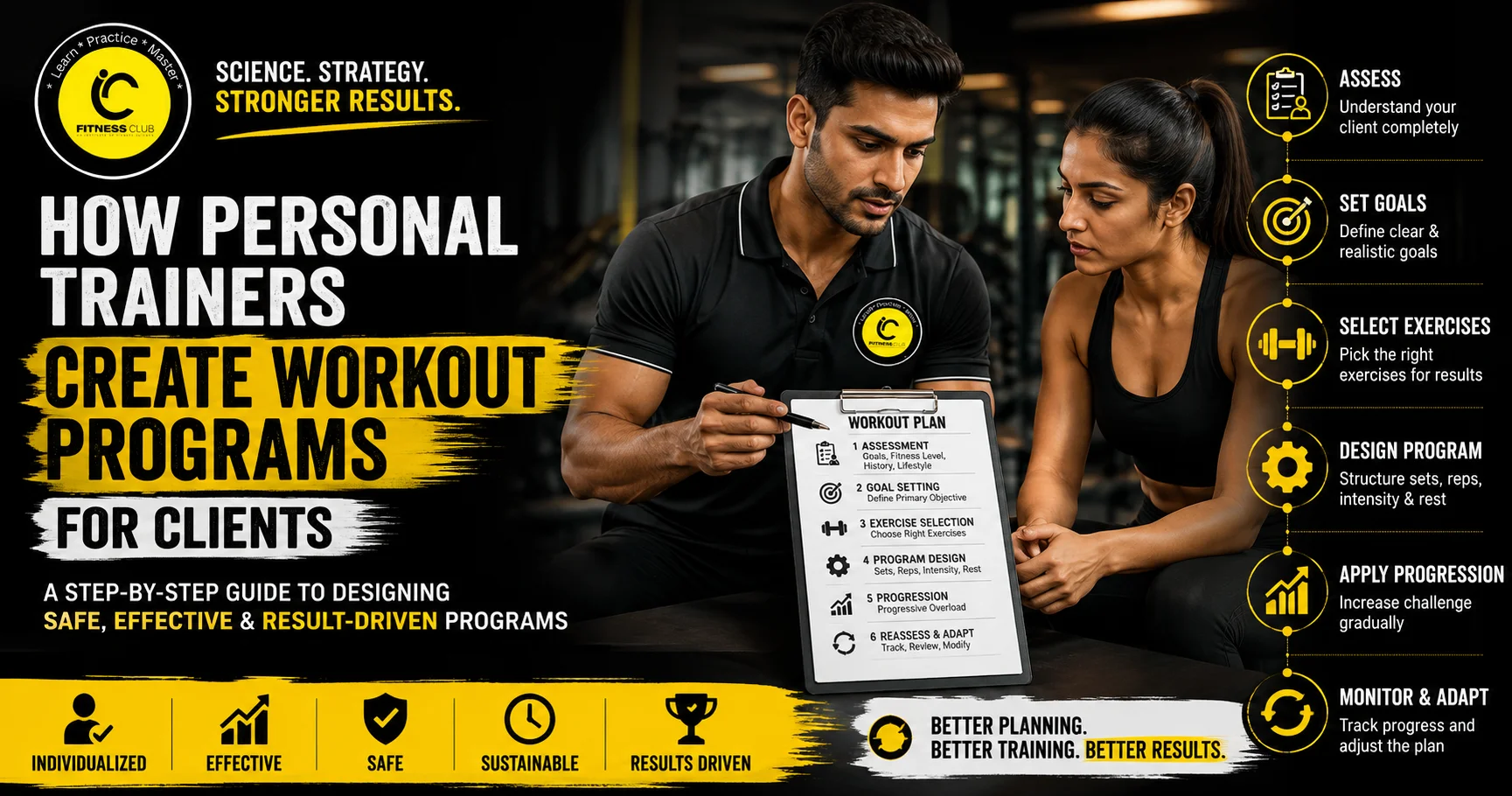
How Personal Trainers Create Workout Programs for Clients: A Complete Guide
Creating a workout program is one of the most important responsibilities of a Personal Trainer. A professional trainer should not simply give every client the same exercises or copy a workout from the internet.
An effective workout program is based on the client’s goals, fitness level, training experience, available time, preferences, and assessment results.
This guide explains how Personal Trainers can approach workout program design, from the initial client assessment to exercise selection, training variables, progression, and reassessment.
What Is a Personal Training Workout Program?
A personal training workout program is a structured plan of exercise designed around an individual’s specific goals and capabilities.
Depending on the client, the program may focus on:
- Fat loss
- Muscle hypertrophy
- Strength
- Cardiovascular endurance
- Muscular endurance
- General fitness
- Mobility
- Sports performance
The program should be individualized rather than based on a one-size-fits-all approach.
Step 1: Start With the Client Assessment
Workout programming should begin with assessment.
Before selecting exercises, a Personal Trainer should understand the client’s:
- Primary goal
- Training experience
- Current fitness level
- Exercise history
- Lifestyle
- Available training days
- Movement capabilities
- Relevant health considerations
- Exercise preferences
A detailed client assessment can provide valuable information for program design.
👉 Read:
Client Assessment for Personal Trainers: Complete Guide & Fitness Tests
The assessment should provide the foundation for the workout program.
Step 2: Define the Primary Training Goal
A program should have a clear primary objective.
For example:
Muscle Hypertrophy
The program may emphasize:
- Resistance training
- Sufficient training volume
- Progressive overload
- Appropriate exercise selection
- Recovery
Strength Development
The program may place greater emphasis on:
- Compound movements
- Higher loads
- Technical execution
- Progressive resistance
- Adequate recovery
Fat Loss
Training may combine:
- Resistance training
- Cardiovascular exercise
- Increased physical activity
- Appropriate recovery
Exercise should be combined with appropriate nutrition and lifestyle strategies rather than relying on exercise alone.
General Fitness
A balanced program may include:
- Resistance training
- Cardiovascular training
- Mobility work
- Muscular endurance
- Functional movement
The training approach should match the client’s actual objective.
Step 3: Decide Training Frequency
Training frequency refers to how often a client trains.
A client might train:
- 2 days per week
- 3 days per week
- 4 days per week
- 5 or more days per week
Frequency should be based on the client’s:
- Goal
- Recovery capacity
- Schedule
- Training experience
- Total training volume
A three-day program that the client consistently follows can be more effective than a six-day program that the client cannot maintain.
Consistency matters.
Step 4: Select the Training Split
Once frequency is established, the trainer can determine how training will be organized.
Common approaches include:
Full Body
Each session trains multiple major muscle groups.
Example:
Monday: Full Body
Wednesday: Full Body
Friday: Full Body
This can work particularly well for beginners and clients with limited training days.
Upper/Lower Split
Training is divided between upper and lower body.
Example:
Monday: Upper Body
Tuesday: Lower Body
Thursday: Upper Body
Friday: Lower Body
Push/Pull/Legs
Training is organized according to movement patterns or muscle groups.
Example:
Monday: Push
Wednesday: Pull
Friday: Legs
The split should be selected based on the client’s goals, schedule, experience, and recovery.
Step 5: Select Appropriate Exercises
Exercise selection is a major part of program design.
A trainer should consider:
- Client goal
- Training experience
- Movement competency
- Available equipment
- Exercise preferences
- Training environment
- Fatigue
- Progression potential
Exercises can include:
Compound Exercises
Exercises involving multiple joints and muscle groups.
Examples:
- Squat
- Deadlift
- Bench Press
- Row
- Pull-Up
- Overhead Press
Isolation Exercises
Exercises that place greater emphasis on a specific muscle or muscle group.
Examples:
- Biceps Curl
- Triceps Extension
- Leg Extension
- Leg Curl
- Lateral Raise
A good program can use both compound and isolation exercises depending on the client’s objective.
Step 6: Organize Exercise Order
Exercise order can influence training performance.
A common approach is:
Warm-Up → Main Compound Exercise → Secondary Exercises → Accessory Exercises → Conditioning → Cool-Down
For example:
- General warm-up
- Squat
- Romanian Deadlift
- Leg Press
- Leg Curl
- Calf Raise
- Optional conditioning
Exercises requiring greater technical skill or higher force production are often placed earlier in the workout when the client is less fatigued.
However, exercise order can be adjusted according to the individual’s goals.
Step 7: Determine Sets and Repetitions
Sets and repetitions should be selected according to the training objective and the client’s experience.
For example, a program may use:
- Lower repetitions with heavier loads for certain strength-focused work
- Moderate repetitions for many hypertrophy-focused exercises
- Higher repetitions for muscular endurance or selected accessory exercises
There is no single repetition range that is automatically correct for every client or every exercise.
The quality of execution and appropriate progression are also important.
Step 8: Determine Training Intensity
Training intensity describes how demanding the exercise is.
For resistance training, intensity can be managed using:
- Load
- Repetitions
- Repetition reserve
- Relative effort
One useful method is RIR (Reps in Reserve).
For example:
2 RIR means the trainer estimates that the client could perform approximately two additional technically sound repetitions at the end of the set.
RIR can help trainers regulate effort without requiring every set to be performed to complete muscular failure.
Step 9: Manage Rest Intervals
Rest periods allow the client to recover between sets.
Rest requirements depend on:
- Exercise
- Training goal
- Load
- Number of repetitions
- Client fitness level
- Fatigue
Large compound exercises may require longer rest periods than smaller isolation exercises.
The goal is to provide enough recovery to maintain appropriate exercise performance.
Step 10: Include Cardiovascular Training When Appropriate
Cardiovascular training can be incorporated depending on the client’s goals.
Options may include:
- Walking
- Jogging
- Cycling
- Rowing
- Swimming
- Stair climbing
- Interval training
The mode, duration, intensity, and frequency should be appropriate for the client’s fitness level and goals.
A beginner may start with moderate-intensity cardiovascular activity before progressing to more demanding protocols.
Step 11: Include Warm-Up and Preparation
A warm-up prepares the client for the upcoming training session.
A warm-up may include:
General Warm-Up
Examples:
- Light cycling
- Walking
- Rowing
- Low-intensity movement
Specific Preparation
The trainer may then use movement-specific exercises or lighter sets of the main exercise.
For example, before heavier squats, the client may perform progressively heavier warm-up sets.
The warm-up should be appropriate to the session rather than unnecessarily long.
Step 12: Apply Progressive Overload
A workout program should provide an appropriate training stimulus and progress over time.
Progressive overload means gradually increasing the training challenge as the client adapts.
Progression can involve:
- Increasing load
- Increasing repetitions
- Increasing sets
- Improving exercise technique
- Increasing training frequency
- Increasing range of motion where appropriate
- Reducing rest in appropriate contexts
- Progressing to a more challenging exercise
Progression should be gradual and appropriate rather than increasing everything at once.
Step 13: Consider Recovery
Training is only one part of the process.
Recovery can be influenced by:
- Sleep
- Nutrition
- Stress
- Training volume
- Training intensity
- Work demands
- Lifestyle
- Rest days
A Personal Trainer should consider the client’s overall recovery capacity when designing the program.
A program that is too demanding to recover from may reduce adherence and performance.
Step 14: Monitor Client Performance
A Personal Trainer should monitor how the client responds to the program.
Track factors such as:
- Exercise performance
- Repetitions
- Loads
- Technique
- RIR
- Cardiovascular performance
- Client feedback
- Recovery
- Adherence
This information can help determine whether the program needs modification.
Step 15: Reassess and Modify the Program
Workout programming should not remain unchanged indefinitely.
Selected assessments can be repeated periodically to determine whether the client is progressing.
For example:
Initial Assessment
- Push-ups: 15
- Plank: 45 seconds
- 1.5-mile run: 16:30
Reassessment
- Push-ups: 24
- Plank: 75 seconds
- 1.5-mile run: 14:50
The trainer can then use the results to determine whether the current program should be maintained, progressed, or modified.
Example: Beginner Full-Body Program
A beginner training three days per week might use a simple full-body structure.
Day 1
- Squat variation
- Horizontal Push
- Horizontal Pull
- Hip Hinge
- Core Exercise
- Optional Cardio
Day 2
- Lunge variation
- Vertical Push
- Vertical Pull
- Hip Extension
- Core Exercise
- Optional Cardio
Day 3
- Squat or Leg Press
- Horizontal Push
- Row
- Hip Hinge
- Core Exercise
- Optional Cardio
The exact exercises, sets, repetitions, loads, and progression should be individualized after assessment.
Example: Hypertrophy-Focused Program Structure
For a client whose primary goal is muscle hypertrophy, a trainer might organize training around:
- Adequate weekly training volume
- Appropriate resistance
- Multiple exercises targeting major muscle groups
- Controlled technique
- Progressive overload
- Adequate recovery
A sample structure could be:
Day 1: Chest, Shoulders & Triceps
Day 2: Back & Biceps
Day 3: Rest
Day 4: Legs
Day 5: Upper Body
Day 6: Optional Lower Body/Weak Point Training
Day 7: Rest
This is only an example. Training frequency and volume should be individualized.
Common Workout Programming Mistakes
Even after completing an assessment, trainers can make programming mistakes.
Using the Same Program for Everyone
A program should reflect individual goals and abilities.
Changing Exercises Too Frequently
Clients need sufficient exposure to exercises to develop technique and measure progress.
Progressing Too Quickly
Increasing training demands too aggressively can compromise technique, recovery, and adherence.
Ignoring Recovery
More training is not always better.
Using Random Exercises
Every exercise should have a purpose within the program.
Focusing Only on Repetitions
Sets and repetitions are important, but exercise selection, intensity, technique, volume, recovery, and progression also matter.
How Client Assessment and Program Design Work Together
Assessment and programming should work as a continuous cycle:
Assess → Plan → Train → Monitor → Reassess → Modify → Progress
The initial assessment provides the information required to create the program.
Training provides the stimulus.
Monitoring shows how the client is responding.
Reassessment provides new information.
The trainer then modifies the program based on the client’s progress.
This is what makes Personal Training individualized rather than simply providing a generic workout.
Frequently Asked Questions
How does a Personal Trainer create a workout program?
A Personal Trainer typically considers the client’s goals, health screening, fitness level, training experience, lifestyle, available time, preferences, and assessment results before selecting exercises and determining training variables.
How many days should a client train?
There is no universal number. Training frequency should depend on the client’s goals, experience, schedule, recovery, and overall program design.
How many exercises should be in a workout?
There is no fixed number. The number of exercises should be appropriate for the session’s goals, training volume, time available, and client experience.
What is progressive overload?
Progressive overload involves gradually increasing the training challenge as the client adapts. This can involve changes in load, repetitions, sets, exercise difficulty, or other training variables.
Should every workout include cardio?
Not necessarily. Cardiovascular training should be included according to the client’s goals, fitness level, preferences, and overall program.
How often should a workout program be changed?
A program does not need to be completely replaced on a fixed schedule. Trainers should monitor progress and make changes when the client’s goals, performance, recovery, or training needs indicate that adjustments are appropriate.
Why Workout Program Design Matters for Personal Trainers
Workout programming is a core skill for any professional Personal Trainer.
At IC Fitness Club – Institute of Fitness Science, students learn exercise programming alongside:
- Human Anatomy
- Exercise Physiology
- Exercise Science
- Kinesiology
- Client Assessment
- Exercise Selection
- Strength & Conditioning
- Nutrition Fundamentals
- Practical Gym Training
The Diploma in Personal Trainer Course combines theoretical education with practical learning to help aspiring fitness professionals develop the skills required for real-world Personal Training.
🎓 Explore the Diploma in Personal Trainer Course:
Final Thoughts
Creating an effective workout program is not about collecting random exercises and putting them into a spreadsheet.
A professional Personal Trainer follows a process:
Assess the client → Identify the goal → Select appropriate exercises → Determine training variables → Apply progressive overload → Monitor performance → Reassess → Adapt the program.
The goal is to create a program that is individualized, purposeful, progressive, and sustainable.
For aspiring Personal Trainers, learning how to design programs based on assessment and exercise science is one of the most valuable skills to develop.
Good programming starts with good assessment.