
Personal Trainer vs Gym Trainer: What’s the Difference?
The fitness industry in India is growing rapidly, creating exciting career opportunities for aspiring fitness professionals. However, many people are confused about the difference between a Personal Trainer and a Gym Trainer.
While both professionals help people improve their fitness, their responsibilities, level of client interaction, training approach, and career opportunities can be different.
If you’re planning to build a career in fitness, getting proper education and practical experience can help you develop the knowledge and skills required to work professionally in the industry.
Who Is a Gym Trainer?
A Gym Trainer generally works on the gym floor and assists members with equipment, exercise techniques, and basic fitness guidance.
Gym trainers may work with multiple members throughout the day and help maintain a safe and supportive training environment.
Responsibilities of a Gym Trainer
- Demonstrating proper exercise techniques
- Assisting members with gym equipment
- Maintaining safety standards
- Providing general workout recommendations
- Supervising the gym floor
- Helping beginners understand exercise basics
A gym trainer plays an important role in helping members use the facility safely and understand basic exercises.
Who Is a Personal Trainer?
A Personal Trainer is a fitness professional who works more closely with individual clients to help them achieve specific fitness goals.
Depending on their education and professional qualifications, Personal Trainers may work with clients pursuing goals such as:
- Fat loss
- Muscle gain
- Strength development
- General fitness
- Improved physical performance
- Exercise adherence
Unlike general gym-floor assistance, personal training typically involves individualized programming, coaching, progress tracking, and regular client interaction.
Responsibilities of a Personal Trainer
A Personal Trainer may be responsible for:
- Conducting fitness assessments
- Designing individualized workout programs
- Teaching exercise technique
- Monitoring client progress
- Adjusting training programs
- Motivating and coaching clients
- Maintaining training records
- Helping clients stay consistent with their programs
Personal Trainer vs Gym Trainer: Key Differences
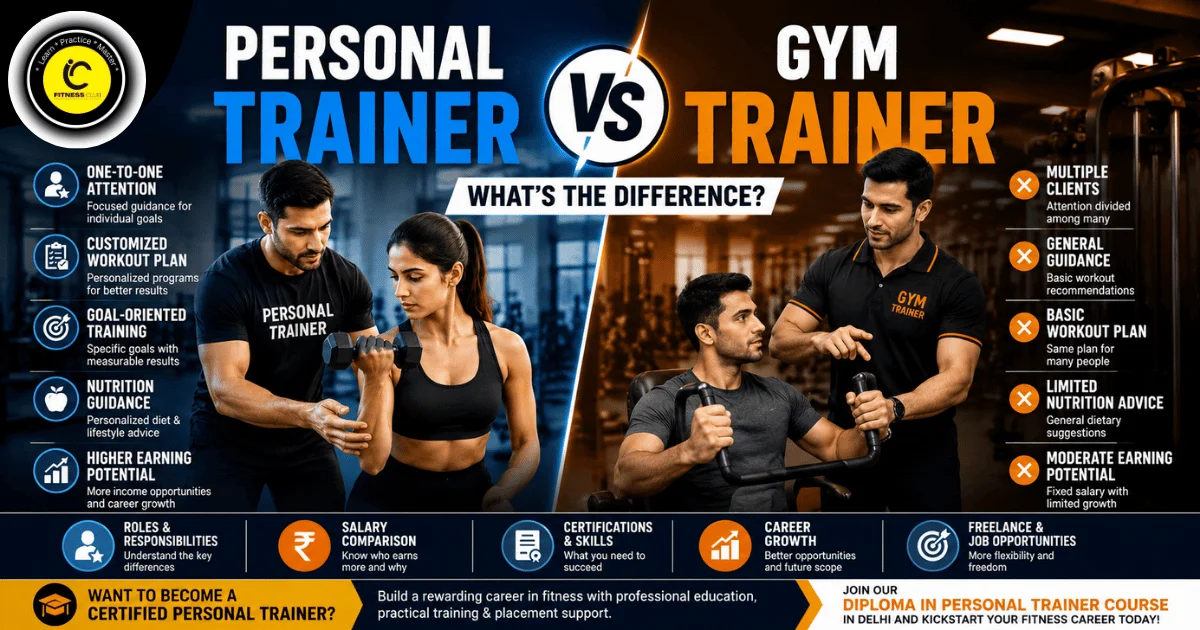
| Feature | Gym Trainer | Personal Trainer |
|---|---|---|
| Client Focus | Multiple gym members | Individual clients |
| Workout Plans | General guidance | Individualized programs |
| Fitness Assessment | Basic or limited | More detailed |
| Client Attention | Shared | One-to-one |
| Progress Tracking | Limited | Regular monitoring |
| Exercise Programming | General | Goal-oriented |
| Coaching | General assistance | Personalized coaching |
| Freelance Opportunities | More limited | Greater opportunities |
| Career Growth | Depends on experience and role | Multiple career pathways |
These are general differences. Actual responsibilities can vary between gyms, employers, and individual professionals.
Personal Trainer vs Gym Trainer: Earning Potential
Earning potential can vary considerably depending on factors such as:
- Location
- Experience
- Qualifications
- Employer
- Client base
- Specialization
- Number of personal training sessions
- Freelance or online coaching opportunities
Gym trainers are commonly employed in gym-floor or general training roles, while Personal Trainers may have additional opportunities to earn through one-to-one training, specialized coaching, freelance work, or online services.
Rather than focusing only on starting income, aspiring fitness professionals should also consider long-term career development, skills, specialization, and the ability to build a client base.
Why Personal Trainers Can Have Greater Career Opportunities
Personal Trainers generally work more closely with individual clients and can develop specialized expertise in areas such as:
- Strength training
- Hypertrophy
- Weight management
- General fitness
- Sports performance
- Functional training
- Online coaching
Experienced trainers can also explore different career paths, including private training, online coaching, fitness management, education, and entrepreneurship.
However, career progression depends on a trainer’s qualifications, practical skills, experience, communication, professionalism, and ability to deliver value to clients.
Skills Required to Become a Successful Personal Trainer
A professional Personal Trainer needs more than knowledge of gym exercises.
Important skills include:
Anatomy and Physiology
Understanding how the human body works and responds to exercise.
Exercise Science
Understanding training principles, exercise technique, and program design.
Client Assessment
Learning how to assess a client’s fitness level, goals, and training needs.
Program Design
Creating structured training programs based on individual requirements.
Communication Skills
Building trust and communicating instructions clearly.
Coaching Skills
Helping clients remain motivated, consistent, and engaged with their training.
Practical Training Skills
Understanding how exercises are performed and how to coach clients effectively in a real gym environment.
A structured Personal Trainer course can help aspiring professionals develop these areas through theoretical education and practical training.
Personal Trainer vs Gym Trainer: Which Career Is Better?
There is no single answer for everyone.
A Gym Trainer role can be a good starting point for someone who wants to gain experience working in a fitness facility and interacting with gym members.
Personal Training can provide a broader range of opportunities for professionals who want to specialize in individualized coaching and develop their own client base.
If your long-term goal is to become a professional fitness coach, developing strong skills in assessment, exercise science, program design, communication, and practical training can be particularly valuable.
How to Become a Personal Trainer
The first step is to develop a strong foundation in fitness science and practical training.
A professional Personal Trainer education program should cover areas such as:
- Anatomy and Physiology
- Exercise Science
- Exercise Technique
- Client Assessment
- Workout Program Design
- Strength & Conditioning
- Nutrition Fundamentals
- Practical Gym Training
After completing your education, gaining practical experience and continuously improving your knowledge can help you develop as a fitness professional.
👉 Explore the Diploma in Personal Trainer Course at IC Fitness Club:
Personal Trainer Course in Delhi | Diploma Program | IC Fitness Club
Career Opportunities for Personal Trainers
A Personal Trainer can potentially develop a career in several areas, depending on their qualifications and experience.
Possible career paths include:
- Personal Fitness Trainer
- Fitness Coach
- Online Fitness Coach
- Strength & Conditioning Coach
- Corporate Wellness Trainer
- Sports Performance Trainer
- Fitness Consultant
- Gym Manager
- Fitness Entrepreneur
The fitness industry also allows experienced professionals to develop specialized services and build their own client base.
Personal Trainer vs Gym Trainer: Final Verdict
Both Gym Trainers and Personal Trainers have an important role in the fitness industry.
A Gym Trainer generally focuses on gym-floor assistance, equipment guidance, safety, and general fitness support.
A Personal Trainer typically works more closely with individual clients and focuses on personalized assessment, exercise programming, coaching, progress tracking, and goal-oriented training.
If you’re looking for a long-term career in fitness, developing professional knowledge and practical Personal Training skills can open up more career pathways.
The right choice ultimately depends on your career goals, education, skills, experience, and professional interests.
Become a Certified Personal Trainer with IC Fitness Club
Building a successful fitness career starts with proper education and practical experience.
IC Fitness Club – Institute of Fitness Science provides Personal Trainer education covering areas such as anatomy, exercise science, client assessment, workout programming, nutrition fundamentals, and practical gym training.
If you’re serious about developing a career as a fitness professional, you can learn more about the Diploma in Personal Trainer Course here:
👉 https://www.icfitnessclub.com/diploma-in-personal-trainer-course/
Frequently Asked Questions
Is a Personal Trainer different from a Gym Trainer?
Yes. A Gym Trainer generally provides gym-floor assistance and general fitness guidance, while a Personal Trainer typically provides individualized coaching and workout programming.
Who earns more: a Gym Trainer or a Personal Trainer?
Earnings vary depending on experience, location, qualifications, employer, specialization, and client base. Personal Trainers may have additional earning opportunities through private, freelance, or online coaching.
Can a Gym Trainer become a Personal Trainer?
Yes. A gym trainer can develop their career by gaining appropriate education, practical experience, and professional Personal Training qualifications.
Is Personal Training a good career in India?
Personal Training can be a rewarding career for people who enjoy fitness, coaching, communication, and working with clients. Career growth depends on education, practical skills, experience, professionalism, and client results.
Related Reading
If you’re interested in building a career as a Personal Trainer, you may also find these guides useful:
How to Become a Personal Trainer in India
https://www.icfitnessclub.com/blog/how-to-become-a-personal-trainer-in-india/
Personal Trainer Interview Questions & Answers: 25 Common Questions to Get Hired
https://www.icfitnessclub.com/blog/personal-trainer-interview-questions-answers-25-common-questions-to-get-hired/
Client Assessment for Personal Trainers: Complete Guide & Fitness Tests
https://www.icfitnessclub.com/blog/client-assessment-for-personal-trainers-complete-guide-fitness-tests/